Lighting a Venetian Mirror So the Glass Reads
How to light a Venetian mirror so facets, engraving and silvering stay legible: placement, color temperature, glare control and candle-style fixtures.
- Published: 15 September 2026
- 1394 words
- 6 min read
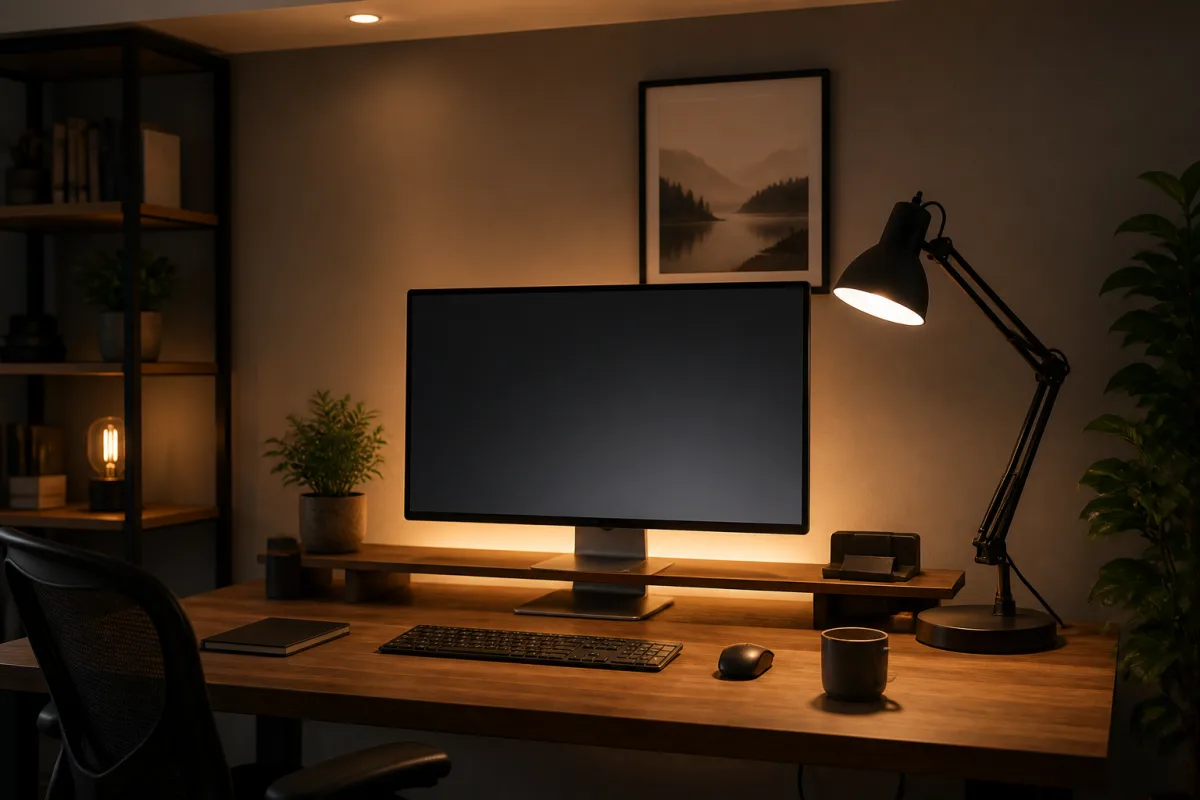
A Venetian mirror reads best when the light comes from the side and slightly above, not from directly in front of it. A single warm source placed off-axis grazes the bevels and facets, so the cut edges catch a bright line while the silvered field stays dark enough to reflect. Light aimed straight at the glass flattens it: the mirror turns into a bright rectangle and the engraving disappears.
The reason is simple. A mirror only shows what it reflects, plus whatever the glass itself does with light. On a plain sheet of glass there is nothing to see but the reflection. On a Venetian mirror the surface is not plain: it carries bevels, facet cuts, engraved motifs and sometimes a border of small shaped pieces, and each of those edges bends light at a different angle. Grazing light makes those angles visible. Frontal light sends the same amount of light back from every point, which is why the ornament vanishes.
Anyone who wants the vocabulary of those cuts and borders before choosing fixtures can find a plain explanation of the forms and the workshop steps at Venetian mirror glasswork explained, which covers history, cutting, faceting and silvering without selling anything. The rest of this article deals with the lighting decision itself.
Where should the light sit relative to the mirror?
Off to one side, and higher than the center of the glass. A wall mirror hung above a console is usually lit by whatever the room already provides, and that is often the problem: a ceiling fixture directly overhead throws light down the face of the mirror and washes it out.
A practical arrangement for a mirror 60 to 90 cm tall is a pair of small sources, one on each side, set roughly 30 to 45 cm out from the wall and about two thirds of the mirror's height above the floor. Angled slightly inward and downward, they graze the surface at a shallow angle. The bevels on the outer frame light up as thin bright lines; the central plate stays comparatively dark and keeps its reflection.
If only one source is possible, put it on the side where the most facet work sits. Asymmetry is not a fault here. A mirror lit from one side reads as an object with depth, while a mirror lit evenly from both sides reads as a flat panel.
Distance matters as much as angle. A source close to the glass creates a small, hard hotspot that the eye cannot ignore. Moving the same source back a meter or more spreads the highlight across the whole frame and softens it.
What color temperature keeps old silvering looking right?
Warm white, in the region of 2400 K to 3000 K, and with a high color rendering index. Antique silvering is not a neutral gray. It carries a faint warm cast, sometimes amber, sometimes a greenish tinge where the tin and mercury or the later silver nitrate layer has aged. Cool white light at 4000 K or above pushes those tones toward gray and makes the glass look dirty rather than old.
A bulb rated at 2700 K with a CRI of 90 or better will show the difference between a clear bevel, a slightly cloudy plate and a patch of worn silvering. Lower CRI sources, common in cheap LED lamps, collapse those distinctions into one flat tone.
Brightness should stay modest. A mirror is a reflective surface, so it returns far more light to the eye than a wall of the same size. Two lamps of 200 to 400 lumens each are usually enough for a domestic setting. Anything above that starts to compete with the reflection, which is the part of the object most people actually want to see.
Dimmability is worth having. Evening light at 20 percent output often shows the facets better than full output, because the eye adapts and the contrast between lit edge and dark plate increases.
How do you light a mirror without glare in the reflection?
Keep the source out of the mirror's field of view, or hide it behind a shade that does the same job. A bare bulb in front of a mirror appears twice: once as itself and once as its reflection, and the reflected copy is usually the brighter of the two.
Three arrangements avoid this. The first is a pair of wall sconces mounted beside the mirror rather than above it, with opaque or densely frosted shades so the lamp itself is not visible from the front. The second is a picture light or a slim linear fixture mounted on the wall above the frame, angled down and forward so its beam crosses the glass at a shallow angle and its own body sits outside the reflected cone. The third is indirect light from a floor lamp or a table lamp placed to the side, aimed at a nearby wall so the mirror receives a broad, soft wash rather than a beam.
Shade material matters. Clear glass shades and exposed filaments produce sharp specular highlights on bevels, which can be attractive in small amounts and distracting in large ones. Fabric, alabaster and opal glass spread the source and reduce the number of hard points.
Does the frame or the hanging height change the lighting plan?
Yes, and the frame usually decides more than the room does. A mirror with a deep crown, the arched top section common on Venetian pieces, throws a shadow band across the upper plate when lit from directly above. Side lighting avoids that shadow and lets the crown read as a separate element.
A mirror made mostly of small shaped pieces, the kind built from dozens of cut tiles, behaves differently again. Each tile has its own angle, so a single grazing source produces a scatter of highlights across the whole surface. That is often the most legible way to show such a mirror, and it needs less light than a mirror with one large plate.
Height follows the same logic. A mirror hung with its center at eye level, roughly 150 to 160 cm from the floor in a standing person's line of sight, will reflect the room and the viewer. A mirror hung higher, common above a mantel, reflects ceiling and upper wall, which are usually the least interesting surfaces in a room. If the mirror must sit high, light it from the sides and keep the ceiling out of the reflection by using a dark or matte ceiling finish nearby.
Oval and cushion-shaped mirrors concentrate their ornament at the rim, so rim lighting from two low side sources works better than a single overhead fixture. Rectangular mirrors with a broad flat border tolerate a picture light above the frame, provided the beam is angled forward enough to miss the top edge.
What should be avoided in a room with a Venetian mirror?
Direct sunlight, unshaded downlights close to the glass, and any fixture that puts a visible bright source in the reflection. Sunlight through a window is the most damaging of the three over time, because it heats the frame and the silvering unevenly and fades the backing. A mirror on a wall that receives strong afternoon sun is better moved, or screened with a sheer curtain during those hours.
Recessed downlights a short distance in front of a mirror are the second common mistake. They create a bright scallop on the upper plate and a dark lower half, and no amount of adjustment fixes it while the fixture stays in that position. Moving the downlight further into the room, or replacing it with a wall-mounted source beside the mirror, solves the problem at the source.
Finally, avoid mixing color temperatures in the same view. A 2700 K sconce on one side and a 4000 K ceiling fixture overhead will make the silvering look inconsistent, warm on one edge and cold on the other. Matching the lamps, or at least keeping them within a few hundred kelvin of each other, keeps the glass reading as one object.
A last practical note on maintenance: dust the frame and the glass with a soft brush before adjusting any lighting. A change in lighting reveals surface condition that was previously invisible, and it is easier to judge the result on a clean mirror than on a dusty one.
For readers who want to check how a mirror behaves under a given lamp before buying fixtures, the US standards laboratory publishes reference material on light, color and measurement that is worth reading alongside any practical test in the room. Its pages are technical rather than decorative, but they explain the vocabulary of color temperature and reflectance that keeps coming up when a Venetian mirror is lit. Treat the reference as background, then judge the glass in place, at night, with the candles or bulbs actually intended for it.