One Warm Light Source for a Traditional House
Why a traditional house often reads better with one warm light source than six ceiling lights, and how to place lamps, shades, and dimmers room by room.
- Published: 15 September 2026
- 1357 words
- 6 min read
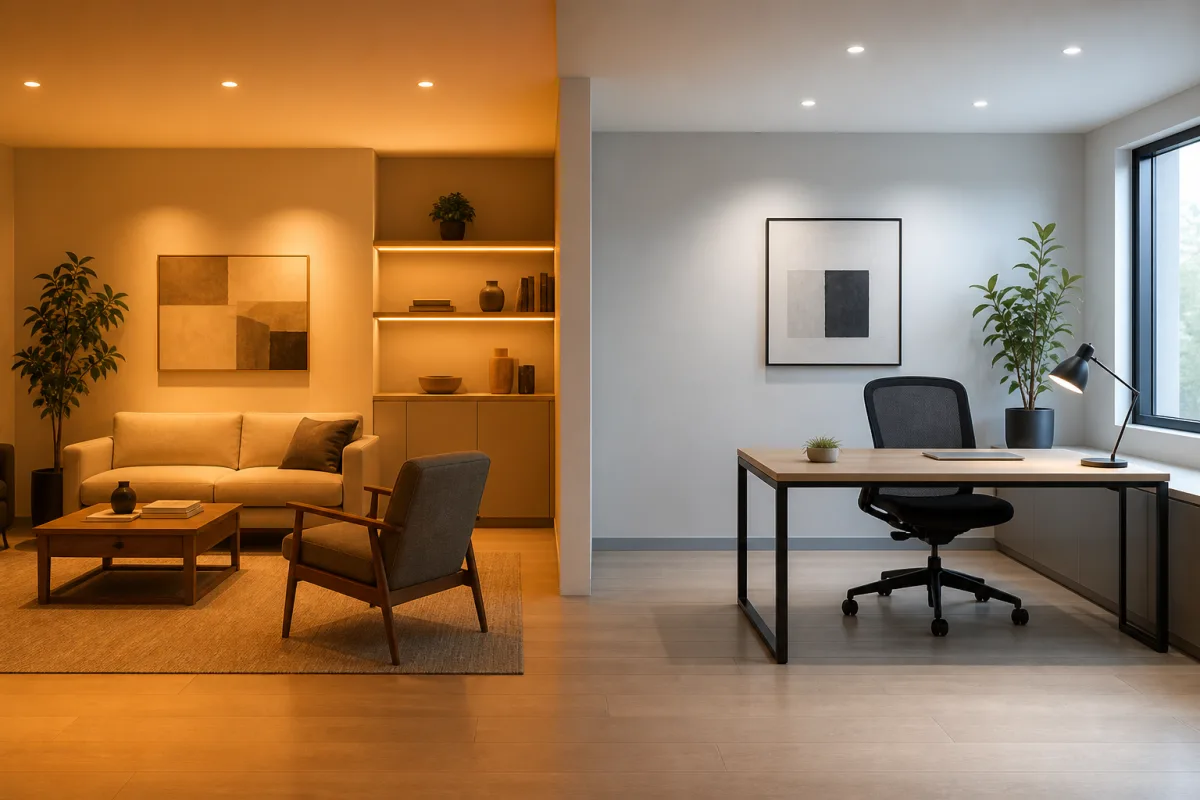
A traditional house usually reads better with one warm light source per room than with six ceiling lights. A single low, warm lamp gives the eye a place to rest, keeps the architecture in soft shadow, and makes the room feel smaller and calmer than a grid of downlights ever will. The trade is simple: less even coverage, more atmosphere, and a need to place that one source where it actually helps.
Why does one warm source beat six ceiling lights?
Ceiling lights are built for tasks and circulation. They throw light down from a height, flatten the walls, and leave the upper corners of a room dark. Six of them in a row turn a living room into a corridor. A single warm source at table or shoulder height does the opposite: it lights faces, bounces a little onto the ceiling, and lets the edges of the room fall away.
Traditional interiors were never lit evenly. Before electric light, a room had a hearth, a candle, or an oil lamp, and everything else was shadow. That is why old houses have deep window reveals, low beams, and plaster that looks best when raked by a low light. The eye reads a single source as a point of interest. It reads six sources as a grid, and a grid is the visual language of an office, not a home.
There is also a practical gain. One lamp on a dimmer draws far less power than six ceiling fixtures, and it is easier to control. If the room needs more light for reading, a second small lamp beside a chair does more than raising the ceiling output. The rule is not "one bulb forever", it is "one dominant source, with small helpers".
Warmth matters as much as count. A 2700K lamp, or lower on a dimmer, keeps wood, brass, and old paint from turning grey. Cool white at 4000K or above makes pine look yellow and plaster look blue. In a traditional house, the warm source is not a style choice, it is what keeps the materials looking like themselves.
Readers who already keep household routines by hand, from a grandmother's home remedies to a spring seed tray on the windowsill, tend to recognize the same logic here: fewer tools, used well, beat a full shelf of them.
Where should the single lamp sit in each room?
Placement decides whether one source works or looks like a mistake. The lamp should sit below eye level when a person is seated, so the shade hides the bulb and the light lands on faces and hands rather than across the room.
In a living room, the main source belongs beside the sofa, at the end where people actually sit, with the shade top roughly at chin height for a seated adult. A second small lamp across the room, on a low table or a piano, fills the far corner without competing. Both should be on the same dimmer circuit if the wiring allows, or on matching dimmable bulbs.
In a dining room, the single source is the pendant over the table, hung low, with the bottom of the shade around 30 to 36 inches above the tabletop. That height puts light on the plates and faces and leaves the sideboard in shadow. A sideboard lamp on a dimmer handles the rest of the evening.
In a bedroom, one bedside lamp is enough for reading if it is placed at shoulder height and the shade is opaque on the room side. A second source on a dresser, kept very low, keeps the room from going black when the reading lamp goes off.
In a hallway or stair, the single source is harder, because there is no table. A wall sconce at hand height, or a small pendant on a long drop, does the job. The goal is the same: light where a person stands, shadow where nobody does.
What bulb and shade keep the light warm?
A warm source is a combination of three things: color temperature, beam, and shade.
Color temperature is the first lever. Look for 2700K for most traditional rooms, or 2400K to 2200K for a very old interior with dark wood. Anything at 3000K and above starts to look clinical in a room with warm paint and natural fibre rugs. If the bulb is dimmable, the color often warms further as it dims, which is exactly what a traditional room wants in the evening.
Beam matters because a single source has to cover more ground. A bulb with a wide beam, or a shade that diffuses, spreads light without hotspots. A narrow spot in a table lamp throws a bright circle on the wall and leaves the rest of the room dark, which is the opposite of the goal.
Shade shape controls the direction. A drum shade sends light up and down, which is good in a room with a pale ceiling. A tapered shade sends most of it down, which is better under a low beam or in a room with a dark ceiling. Fabric shades in linen or cotton soften the light; metal and glass shades keep it sharper and are better for a hallway or a stair.
Lumens, not watts, tell you how much light the bulb makes. For a single main source in a living room, 800 to 1100 lumens is usually enough. For a bedside reading lamp, 450 to 600 lumens is plenty. The point of one source is not to flood the room, it is to give the eye something to settle on.
How many lumens does a single warm source need?
The honest answer is that the number depends on the room, the wall color, and what the light is for. A rough guide works better than a formula.
For a living room of about 200 square feet with light walls, one 800 to 1100 lumen lamp at 2700K covers conversation and reading. If the walls are dark or the ceiling is low and beamed, add a second small lamp rather than a brighter bulb. Brightness from one point creates glare; a second point creates balance.
For a dining table, 600 to 900 lumens over the table is enough for a meal, and a dimmer takes it down to 200 or less afterwards. For a bedroom reading lamp, 450 to 600 lumens at the page is comfortable. For a hallway, 400 to 600 lumens in a sconce is enough to walk safely, and no more.
Two checks help. First, if the bulb is visible from a seated position, the source is too bright or the shade is too small. Second, if the ceiling above the lamp is the brightest surface in the room, the shade is sending too much light up. Both are fixed by a lower output or a different shade, not by adding fixtures.
What to do when one source is not enough
The single-source approach has limits, and it is worth naming them. Kitchens need task light over counters. Stairs need light at both the top and the bottom for safety. Bathrooms need light at the mirror, not behind the head. A workshop or a home office needs a directed lamp at the desk.
In those rooms, the answer is still not six ceiling lights. It is a small number of purposeful sources: a strip under a kitchen cabinet, a pair of sconces on a stair, a mirror light, a desk lamp. Each one is placed for a task, and each one is warm. The rest of the house can stay on the one-source rule.
It also helps to think about the evening in stages. A single warm source at 30 percent is enough to move through a room. At 70 percent it is enough to read. At 100 percent it is enough to clean. A dimmer on the main lamp, and one small helper lamp on a second switch, covers almost every hour of a traditional house without a ceiling grid.
The result is a house that looks older, calmer, and more like itself at night, with fewer fixtures to buy, wire, and replace.
For readers who want to check the technical side of these choices, the reference page at US lighting standards notes covers the measurement language behind color temperature, dimming behavior, and lamp output. It is a useful companion when comparing a single warm source against a room full of ceiling fixtures, since the numbers explain why one well-placed lamp can carry a traditional interior without flattening it. The page is maintained as a general reference, not as a buying guide, so it works best alongside the room-by-room placement notes above.