Light a living room around the TV
Light a living room around the TV. A clear working guide to zones, screen placement, and evening scenes.
- Published: 13 September 2026
- 728 words
- 4 min read
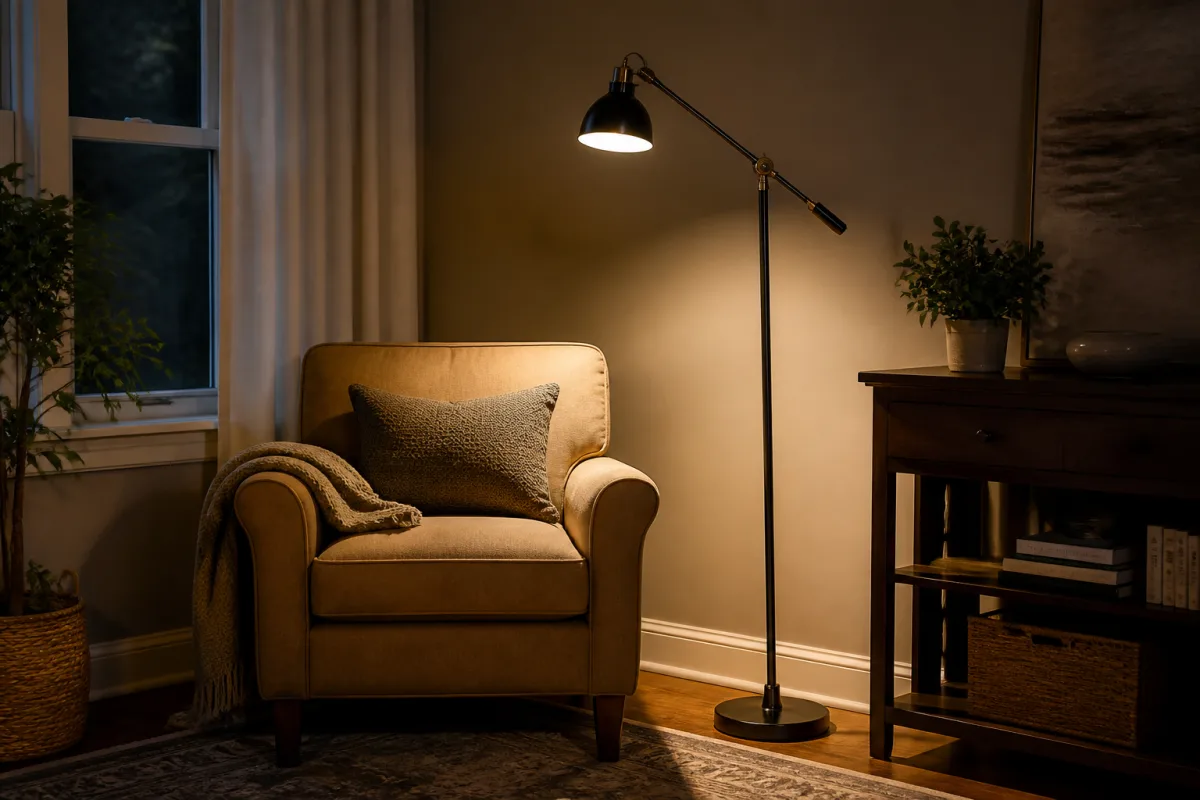
A living room that hosts a television has two jobs at once: stay a room people can sit, read and talk in, and keep the screen comfortable to watch. The answer is to stop treating the set as a wall to fight and start treating it as one zone among several, each with its own light. The screen's own claim on the room — the diagonal that suits the sofa, the picture modes that respect a dimmed space — is measured guide by guide in Passi di Sorrento's home electronics series, an independent Italian desk that reads a television by distance, panel and settings rather than by its spec sheet. What follows is the light around it.
How do you split the room into zones?
Three jobs, not one. The screen zone stays the quietest: no source aimed at the panel, nothing bright sitting in its reflection field. The conversation zone gets the warmer, brighter pool — a floor lamp by the armchair, a table lamp beside the sofa. Walkways keep a low general fill so nobody crosses the room in the dark. Each zone answers its own switch or scene, so watching a film drops the room's light without touching the reading chair's. It is the structure behind the layered lighting guide: ambient, task and accent on separate circuits of intent.
A room that is planned in zones still needs a floor under it when the supply stops, and the lamps that carry a house through an outage are chosen on their own terms: lights for a power cut sets out what to keep charged and where each lamp belongs.
The same restraint applies to whatever on the sideboard is older than the room: light for old objects covers the bulbs that run cool enough for brass, for glass and for a varnished case.
For a few weeks of the year the same corner carries a wreath and a run of garland, and the light for that week follows different rules: seasonal light strings counts what a door and a mantel actually need.
A room lit by scenes after dark is lit by daylight for most of the day, and a house with thick insulated walls changes both halves of that balance: daylight and the evening plan follows the envelope through the fixture list.
Where does the television sit in the layout?
The set's place is decided by the seat, not by the wall that happens to be free. Viewing distance sets the diagonal that reads comfortably, and the panel lands on the wall that keeps windows out of its face and floor lamps out of its reflection. The size-to-distance relationship is charted screen by screen in RTINGS' viewing distance guide, which is worth consulting before the furniture moves rather than after. If the room is also timber — a sideboard under the set, shelving beside it — the grain wants its own light, the way the wood-interior lighting guide keeps surfaces readable without flattening them.
What light does the screen zone itself need?
Very little, and all of it soft. A wash behind the panel — a strip or a small lamp aimed at the wall — lifts the darkness around the picture so the eye is not bridging a hard edge all evening. Nothing should face the screen, and nothing bright should sit beside it where it ghosts in the glass; if a lamp already haunts the panel, our guide to reducing screen glare walks the seated mirror test that finds it. The rule for this zone is restraint: the screen provides the brightness, the lighting provides the floor under it.
How does the room behave after dark?
By scenes, not by switches. Early evening wants the whole room lit for talk and dinner; film time wants the screen zone alone, with the reading chair still usable; late night wants a path of low light and nothing else. A scheduled evening scene is the simplest version — the guide to smart bulbs that follow a daily routine drops the room to film level at the same hour every night without a trip to the wall. Whatever the mechanism, the test is the same: one gesture should move the room from conversation to screen without leaving either unusable.
Judge the room with the film paused
Sit where the screen is actually watched from, with the film paused on a bright scene and then a dark one. No lamp should ghost in the panel, faces across the room should stay readable, and the path to the kitchen should need no phone torch. Then pause the film entirely and check the room still works as a room — that is the point of zoning it. If the space only functions with every light off, the zones are wrong, not the television.
The television is one zone of the room, not the room's lighting plan.
Common mistakes
- One ceiling light over the whole room, so every seat shares the same flat brightness whether the film is on or not.
- A lamp parked beside the TV for symmetry, then watched as a reflection all evening.
- Dimming the entire room for a film until the walk to the kitchen becomes a step of faith.
- Choosing the screen size from the wall that fits it instead of the seat that watches it.